All posts filed under: Africa

An Ode to a Hippo

First published on Royal Chundu’s blog. It was morning, becoming late morning quickly. As it does when your head is under the duvet, denying the intrusion of sunlight. And you, an early riser, always, you let me lie in. You didn’t make a sound. I would have heard; I was listening closely, waiting for you. It was the last morning and I wasn’t ready to say goodbye. Perhaps you weren’t either. Perhaps that explained your silence. Words are never enough, are they? With soulmates we hope that mind-reading will suffice and in a way, at least for that moment, the head-under-the-covers moment, it did, even if I misread the signs, painted them with my own hopes. What was I hoping for? I guess that you were sad too. I would never know; you didn’t even have the sleeves to wear your heart on. I hoped that you would miss me and that even though our homes were in separate parts of the world, our connection would remain. I hoped that part of you would stay with …
Where Angels Fear to Tread

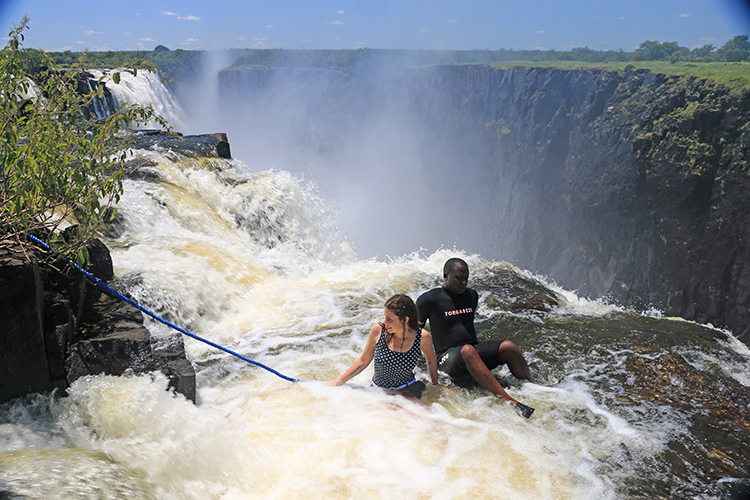
Read the article on Royal Chundu’s blog here. “Beyond the edge of the world there’s a space where emptiness and substance neatly overlap, where past and future form a continuous, endless loop. And, hovering about, there are signs no one has ever read, chords no one has ever heard.” ― Haruki Murakami, Kafka on the Shore I had to see what lay at the edge of the Victoria Falls, from the view of the Angel. I had visited with the Devil before, taken up his challenge and swum to the outer limits. I had felt fear, but more importantly a deep desire to trust. To believe the guides when they told me that I would be ok. The water would not take me with it as it cascaded over the edge, into the fiery gorge below. This time the same desire arose, as my guide’s hand led me along a plank (*pushes pirate ship references out of mind*) along the rocks of this shallow section of the Zambezi River, on Livingstone Island, into what is known as Angel’s Pool, a few …

Nightswimming With Elephants

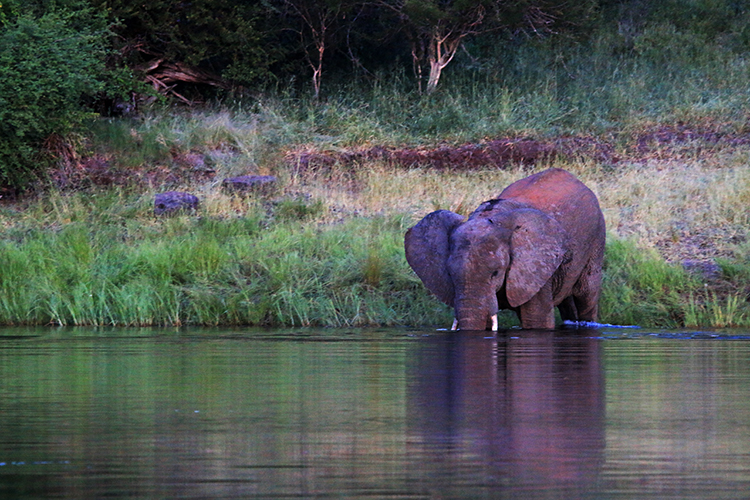
As published on Royal Chundu’s Blog. “I often think that the night is more alive and more richly colored than the day.” – Vincent Van Gogh The starry night without doubt transfixed the painter who once uttered the words above, and it captivates us no less. But even more enthralling, we think, is that time before the sun goes down. The truly alive, truly colourful time called dusk. On the open Zambezi, dusk presents itself each night in the most beautiful of sunsets. Sunsets we never tire from photographing in their unique nightly manifestations. It is during this cooler time of day that you can sometimes glimpse the odd herd of elephant down at the riverbank, engaged in a spot of skinny-dipping. They might have hoped that the dim light would shield them from us, but our camera lenses pulled it off and captured the nightswimmers in action from the sturdiness of our sunset cruise boat. Before the sky completely turned from purple to black and left us with nothing but the moon to guide us home, we snapped these images …

The Real Mystery of Wildlife Photography

Published here – Relais & Châteaux Africa Wildlife photographers are the impalas of the human world. They are everywhere. As you leave the airport, en route to the safari lodge, on the lawn at lunch, under the trees and across the plains on just about every game drive. Yes, many of these photographers are truly talented individuals with an impeccable eye, superb mastery of the machine, and, well, really good cameras. Many of us are guilty of using these connoisseurs of the camera as an excuse to not try our own hand at the art. If someone else can do it better, why bother? Perhaps you’ve never thought this. Perhaps you just don’t see the attraction of photographing wildlife. But like other art forms, photography is about so much more than the product. The whole process awakens us to the little wonders and idiosyncrasies of life – its quirks that often go amiss otherwise … Like the tight scrunch of a leopard’s nose. The twitch of a lion’s whiskers. The endless fly-eyes of the impala. The knees – or are they elbows – of the …

The Ubuntu Birds

[Published here] “I once had a sparrow alight upon my shoulder for a moment, while I was hoeing in a village garden, and I felt that I was more distinguished by that circumstance that I should have been by any epaulet I could have worn.” – Henry David Thoreau To make up for not giving me siblings, my parents gave me pets. There was the Manx cat that slept in the tumble drier. The ginger tabby that trailed after us on walks around the neighbourhood. The dogs that let me dress them up in sunglasses and ties, that escorted me through the forest or along the beach. And then there were the birds. While my father’s father bred show pigeons, my father bred everything: quails, lovebirds, finches, Cockatiels, budgies and, most recently, an owl mother and her fledgling. On roadtrips, I might not have known the joy of sharing the backseat of the family car with anyone, but I knew my birds. I loved how they all seemed to have a place in the aviary …

The Parrotfish Run

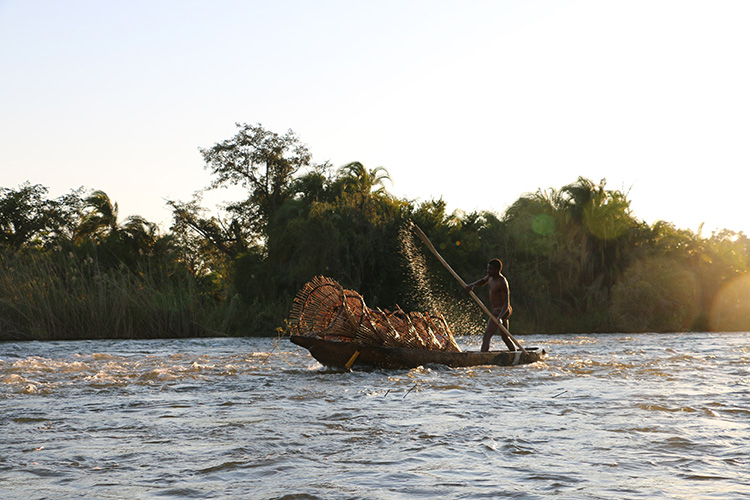
First published on Royal Chundu’s blog here. Everyone has their own criteria for what makes an adventure. For me, it is often about my camera and the rare moments it manages to capture. The Parrotfish Run in Zambia, the Zambezi’s Great Migration, is one such moment. After watching mokoro after mokoro glide past my deck at Royal Chundu‘s Island Lodge, I joined the fishermen on the Zambezi, with Royal Chundu Head Guide, Sililo, or “SK”. Our vehicle: an inflatable canoe. The Parrotfish Run is a decades-old tradition. Each year, from around June to August, millions of these fish are pulled downstream by the main river current. The usually serene upper reaches of the Zambezi transform into a lively harbour with women and children on the sidelines and fishermen spread across the channels – often thigh-high in the water, sometimes even immersed up to their necks. Hessah Silwebbe, manager at Royal Chundu, set on a private waterway between the two rapids where the fishing takes place, explains, “Once the fish hit the smaller rapids, they make for an easy catch …

How To Be Quiet – Unexpected Lessons From Unexpected Guests

A dispatch from the Royal Chundu blog We are very grateful for this blog and are greatly saddened when the noise of the outside world keeps us from it. Partly because it allows us, as Anaïs Nin wrote, to taste life twice, and partly because it reminds of the little things that bring us joy, the odd ‘aha moment’ that is easy to forget in the flurry of daily life. For instance, the subjects of today’s blog… Recently, we had two of the quietest guests we’ve ever come across. They arrived in a uniquely quiet week at Royal Chundu – as if they had sensed the stillness of the lodge, even months before when they booked their trip. They stayed with us for just over a week on a birding safari. Sure, birders tend to be a characteristically quieter breed compared to the rest, but there was something special about this couple. They were so quiet that we didn’t know how to entertain them. But therein lay the answer – they didn’t need to be entertained at all. In the way of the books by …

The Armchair Safari

Since I was a lone girl child, my father and I have been talkers. We don’t talk to other people much, but we talk to each other. About other people. But also about big ideas. Philosophy. Politics. Plants. Every and anything. It has been a way of working through the commodious complexity of daily life. A method for understanding ourselves as much as the world outside of our small sphere. These days, when I return from assignments out in the bush, we sit across from each other on big leather couches in the family lounge, my mother beside us, completing our sphere. And we talk. We drink tea and we talk. About everything from poached eggs to poaching. About the warthogs I met. “Do you think I could keep one in my flat? They’re just like fat puppies.” About the lions. “You were right, Dad. I’m a wimp.” About the colours, the smells, the sounds of safari. The talking can go on for days, as new memories return. Like a sort of Armchair Safari. In a way, this blog at Relais & Châteaux …

Tanzania’s Best Kept Secret

The Other Pemba Tamlin Wightman discovers there’s more to this tiny Indian Ocean island off Tanzania than diving. It started with a touch. The touch of a child’s soft, plump hand in mine. So timid that it didn’t linger long and was quickly retrieved by its owner. All around kids were screaming at me like banshees. ‘Mzungu! Mzungu!’ White person! The crowd of about 20 little mites had chased after me as I passed through their village, Kijijini, on Pemba Island, named Jazirat al- Khadhra, the Green Island, by an Arab geographer. Some kiddies were naked, some just pulling on their dresses or shorts after enjoying the beginning of the monsoon rains. Once one of them had felt the strange pale skin, all wanted a turn. If you let it, Pemba Island will touch you in many ways. It’s hillier and more lush than neighbouring Unguja (known incorrectly as Zanzibar), with which it makes up the Zanzibar Archipelago within the union of Tanzania. Some say it’s Tanzania’s best-kept secret. Tourists of the more usual sort …